
January 23, 2026
If you are living with a disability (or caring for a loved one who is disabled) in Montgomery County, MD and you’re struggling with day-to-day tasks, feeling burnt out from providing care, or are simply looking for extra support, this article is for you.
Maybe you’re noticing:
- You’re falling more often or experiencing near-falls
- Missed medications
- An inability to cook, so you’re skipping meals
- Difficulty traveling to medical or personal appointments because of your disability
- A decline after a hospital stay.
Or maybe the issue is simpler, but just as crucial: your loved ones are doing everything they can to help you, but it’s becoming too challenging to manage without help.
The good news is that personalized in-home support can reduce stress and help you or your loved one stay comfortable and cared for at home.
In this article, you’ll learn:
- Who needs (and who doesn’t need) disability home care?
- What does disability home care often include and look like?
- What are signs you or your loved one may need in-home support?
- How can you decide which agency is best for you or your loved one?
- How can you start care successfully?
We serve Montgomery County, including Rockville, Bethesda, Silver Spring, Gaithersburg, Germantown, Potomac, Wheaton, and Takoma Park. If you want help finding in-home care and support, call for a free care consult and we’ll determine if and how we can help you.
Who typically needs disability home care in Montgomery County?
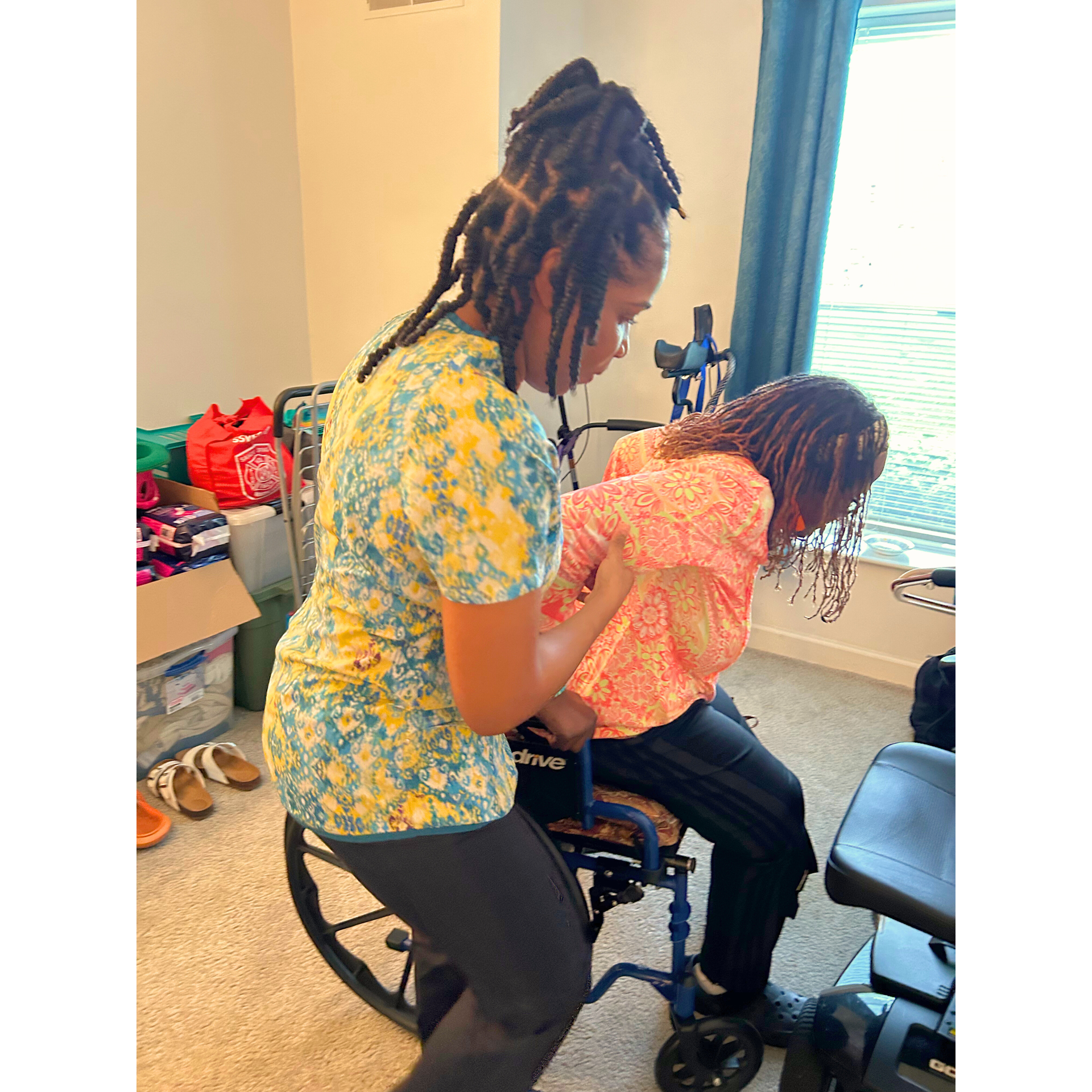
“Disability” can look different for every person and family. For Specialty Care Services, disability home care often supports:
- Adults with mobility limitations
Wheelchair use, balance issues, recovery after surgery, or chronic fall risk.
- Neurological conditions
Stroke recovery, MS, Parkinson’s, traumatic brain injury (TBI), or nerve-related weakness that affects gait, coordination, or fatigue.
- Developmental or intellectual disabilities
Some individuals benefit from routine support, prompting, transportation, and caregiver consistency.
- Chronic illness + fatigue/weakness
When energy is limited, small tasks become big barriers, including meals, showers, stairs, and medication schedules.
- Family caregiver support needs
One of the most common motivations for families seeking care is caregiver overload. The National Institute on Aging emphasizes the importance of caregiver support and planning services that help people remain at home safely. [2]
What services are often included in disability home care?
Below are a list of services that are often provided to those with disabilities. If you call us or schedule an appointment, our first initial assessment will help us determine which services are most appropriate for you or your loved one. We then share with you a personalized care plan that explains which services we will provide.
When most people search “disabled home care” or “special needs home care,” they’re usually looking for practical, day-to-day help at home with support that makes life safer and more manageable, including:
1. Personal care & day-to-day task assistance
Hands-on help that protects comfort and safety:
- Bathing or shower support (including safe transfers)
- Grooming and dressing assistance
- Toileting support and hygiene routines
- Mobility assistance (walking support, wheelchair transfers)
Example: A caregiver arrives in the morning to help with a safe shower routine, dressing, and setting up the day so the client can conserve energy for work, therapy, or activities.
2. Home safety + routine support
The goal here is consistency and fewer risky moments:
- Fall-prevention habits (lighting, pathways, footwear routines)
- Meal prep, hydration reminders, and simple nutrition support
- Light housekeeping to reduce clutter and trip hazards
- Prompting/cueing for routines when attention or memory is affected
Example: If fatigue hits hard in the afternoon, an aide helps with meals, hydration, light cleaning, and prepping the evening routine so nights are less stressful.
3. Medication support
This may include:
- Medication reminders and schedule tracking
- Pickup coordination with the pharmacy
- Family updates when adherence is slipping
Important note: Medication administration or skilled tasks should only be done by qualified, licensed professionals when required.
4. Transportation & errands
Keeping life moving outside the home:
- Rides to appointments
- Grocery and essential errands
- Community engagement to prevent isolation
Example: A caregiver helps a client get ready, travels with them to physical therapy, and brings them home safely. This can reduce risk and caregiver strain.
5. Respite care for family caregivers
Respite care provides temporary coverage so family caregivers can rest. The Alzheimer’s Association explains respite as a way for caregivers to get a break while the person receiving care remains safe. [4]
Example:
A family caregiver gets four hours of coverage twice a week to work, sleep, or attend personal appointments.
Sometimes skilled services are required, including clinical support such as home nursing or private duty nursing. If you’re unsure, Specialty Care Services will help you clarify whether you need supportive caregiving, skilled home health care, or a combination. [1]
Signs it’s time to get help at home
Most families can utilize this list immediately. If you or your loved one check even a few of these boxes, in-home care and support may be beneficial.
Have you or your loved one experienced in the past year:
- Falls or near-falls (especially in the bathroom, stairs, or at night)
- Missed meds, confusion, or duplicates (or frequent “I already took it” uncertainty)
- Skipping meals, weight loss, or dehydration
- Trouble bathing, toileting, or changing clothes safely
- Caregiver exhaustion (irritability, missed work, burnout, resentment, sleep loss)
- Frequent ER visits or a sudden decline in health on a regular basis
When these signs appear, support can reduce crisis moments and help you avoid emergencies. Our in-home care services are often used short-term after a hospital stay or long-term for ongoing support, depending on needs. [2]
How do you choose the “right” care?
Choosing the best agency for you or your loved one can be the difference between healing and wellbeing, or declining health and emergencies.
You can use this list to compare any in-home care agency:
- Easily understandable scope of care: do they explain what they can and can’t do? [1]
- Background checks and verification for caregivers
- Training for transfers and fall prevention
- Disability-relevant experience (mobility, transfers, cognitive support, special needs)
- Transparent care plan process: assessment + written plan + goals
- Regularly scheduled reassessments: how often do they re-evaluate needs?
- Caregiver consistency: do they provide the same quality of caregiving every day?
- Supervision and oversight including RN oversight if applicable
- Family communication cadence: how often are they sending you and your family messages? What are included in those communications?
- Schedule flexibility: plans around you and your family’s schedule
- Backup plan: what happens if the caregiver calls out last-minute?
- Emergency protocols: how do they handle falls, confusion, wandering risk, or sudden decline?
- Documentation: clear visit notes and service tracking
- Reviews and references: evidence of reliability and responsiveness
This list is commonly recommended in elder law hiring guidance. [10]
You can also read our blog on this topic:
How to Choose an In-Home Care Agency for Your Senior Loved One in Montgomery County, MD: 12 Must-Ask Questions (With Expert Answers)
How to Start Care: A Step-By-Step List
Getting high-quality home care doesn’t have to be complicated. Here is our simple process:
1. Initial phone screening
You share your situation, preferences, schedule needs, and safety concerns.
2. Personalized In-home assessment
A registered nurse evaluates capabilities, mobility, routines, and risks.
3. Care plan + schedule
Clear tasks, shift times, and goals.
4. Caregiver match
Combining skills, personality, and preferences match.
5. Start of care
Educating both our client and their family about what care includes.
6. First-week check-in
Adjust schedule, tasks, and caregiver as needed.
7. Ongoing reassessments
The care plan evolves as needs change.
This is especially important when a family is dealing with memory loss, progressive conditions, or post-hospital transitions. [2]
How to pay for disability home care in Montgomery County
Common ways families afford care:
- Private pay
- Long-term care insurance (coverage varies by plan)
- Veterans benefits (for eligible veterans/spouses, depending on program)
- Maryland Medicaid home and community-based services (HCBS)
Maryland Medicaid describes HCBS options for older adults, people with disabilities, and children with chronic illnesses, often through Medicaid programs and waivers with differing eligibility criteria. [6]
Tip: Even if you plan to start privately, it can be smart to learn what programs exist. Give us a call to learn about your options.
Frequently Asked Questions (FAQ)
1. What’s the difference between home care and home health?
Home care usually focuses on daily living support such as bathing, meals, mobility, and routine safety.
Home health care generally refers to skilled clinical care (nursing, therapy, wound care) ordered by a clinician and provided by licensed professionals. [1]
2. How many hours of care do most disabled adults need?
It depends on many factors, including safety risk, mobility, and caregiver availability.
Many of our clients start with 6–12 hours per week for bathing, meals, and errands. Some need daily support or overnight coverage. Our in-home care assessment can help us understand how much care is required at the start of care and can adjust the number of hours as needs change. [2]
3. Can home care help prevent falls?
A consistent routine, safer pathways, transfer support, and help with bathing/toileting can reduce fall risk, especially at night or in the bathroom. Fall prevention is one of the main reasons families seek home-based support early to prevent an injury. [2]
4. Can I start care temporarily after a hospital stay?
With Specialty Care Services, Yes. Home-based support can be short-term during recovery or long-term for ongoing needs. Post-Hospital care can reduce problems like missed meds, weak mobility, and unsafe routines. [2]
5. How fast can home care start in Montgomery County?
At Specialty Care Services, we provide an initial assessment and start giving you or your loved one care 24-48 hours after you contact us. This makes getting care fast and easy.
If you’re in Montgomery County, MD and you need disability home care, whether it’s personal care support, caregiver relief, dementia home care, Alzheimer’s home care, or help coordinating the right level of home health care, you don’t have to figure it out alone.
Call us for a free initial assessment
and we’ll help you choose the safest next step, build a realistic schedule, and match care to you or your loved one’s needs.
Sources
- National Institute on Aging (NIA) — Services for Older Adults Living at Home.
https://www.nia.nih.gov/health/caregiving/services-older-adults-living-home
Accessed January 2026.
2. National Institute on Aging (NIA) — Aging in Place: Growing Older at Home.
https://www.nia.nih.gov/health/aging-place/aging-place-growing-older-home
Accessed January 2026.
3. The Arc Montgomery County — Respite Coordination (Overview).
https://thearcmontgomerycounty.org/what-we-do/respite/overview-respite.html
Accessed January 2026.
4. Alzheimer’s Association — Respite Care.
https://www.alz.org/help-support/caregiving/care-options/respite-care
Accessed January 2026.
5. Maryland Access Point — In-Home Support / Long-Term Caregiving.
https://marylandaccesspoint.211md.org/home/
Accessed January 2026.
6. Maryland Department of Health (MMCP) — Home and Community-Based Services (HCBS).
https://health.maryland.gov/mmcp/waiverprograms/pages/home.aspx
Accessed January 2026.
7. Maryland Department of Human Services — In-Home Aides Services.
https://dhs.maryland.gov/office-of-adult-services/in-home-aides/
Accessed January 2026.
8. Montgomery County, MD — Home Care / In Home Aide Services (IHAS).
https://www.montgomerycountymd.gov/HHS-Program/ADS/ADSHomeCare-Aide-IHAS-p181.html
Accessed January 2026.
9. Alzheimer’s Association — In-Home Care.
https://www.alz.org/help-support/caregiving/care-options/in-home-care
Accessed January 2026.
10. ElderLawAnswers — Checklist: Hiring a Home Care Provider.
https://www.elderlawanswers.com/checklist-hiring-a-home-care-provider-12186
Accessed January 2026.
11. MedlinePlus Magazine — Home sweet home: Supporting a loved one aging in place.
https://magazine.medlineplus.gov/article/home-sweet-home-supporting-a-loved-one-aging-in-place
Accessed January 2026.